The Chain Rule
Differentiate (3x² + 1)⁴ with the chain rule: derivative of the outside, times derivative of the inside, giving 24x(3x² + 1)³.
Narrated by a synthetic voice (Piper TTS, en_US-ljspeech-high voice (LJ Speech dataset, public domain)). Download MP4 (0.6 MB) · Captions (WebVTT)
On-screen maths
Every board from the lesson, so you can read it at your own pace or copy it into your notes.
- 1. Spot the composition0:00
- 2. The rule0:14
outside derivative times inside derivative
- 3. Apply it0:23
- 4. Recap0:39
- Name the inside function .
- Differentiate the outside, leave alone.
- Multiply by . Forgetting it is the most common mistake.
About derivatives
Power, product, quotient and chain rules.
Practise what you just watched
A direct application of the power rule.
A product of two functions needs the product rule.
The chain rule with a linear inner function.
Chain rule with the natural logarithm.
- Derivative Calculator: try the same kind of problem with your own numbers.
- Implicit Differentiation Calculator: try the same kind of problem with your own numbers.
- More calculus practice problems
- Limits Study Guide (study guide)
- AP Calculus AB Unit 3: Differentiation: Composite, Implicit and Inverse Functions: the AP unit this lesson supports.
- Calculus calculators and topics
- Step-by-step solver: check your own answer with hints.
Unofficial study material. This site is an independent educational resource and is not affiliated with or endorsed by the College Board. AP® is a trademark registered by the College Board, which is not involved in producing this content.
More video lessons
 0:50
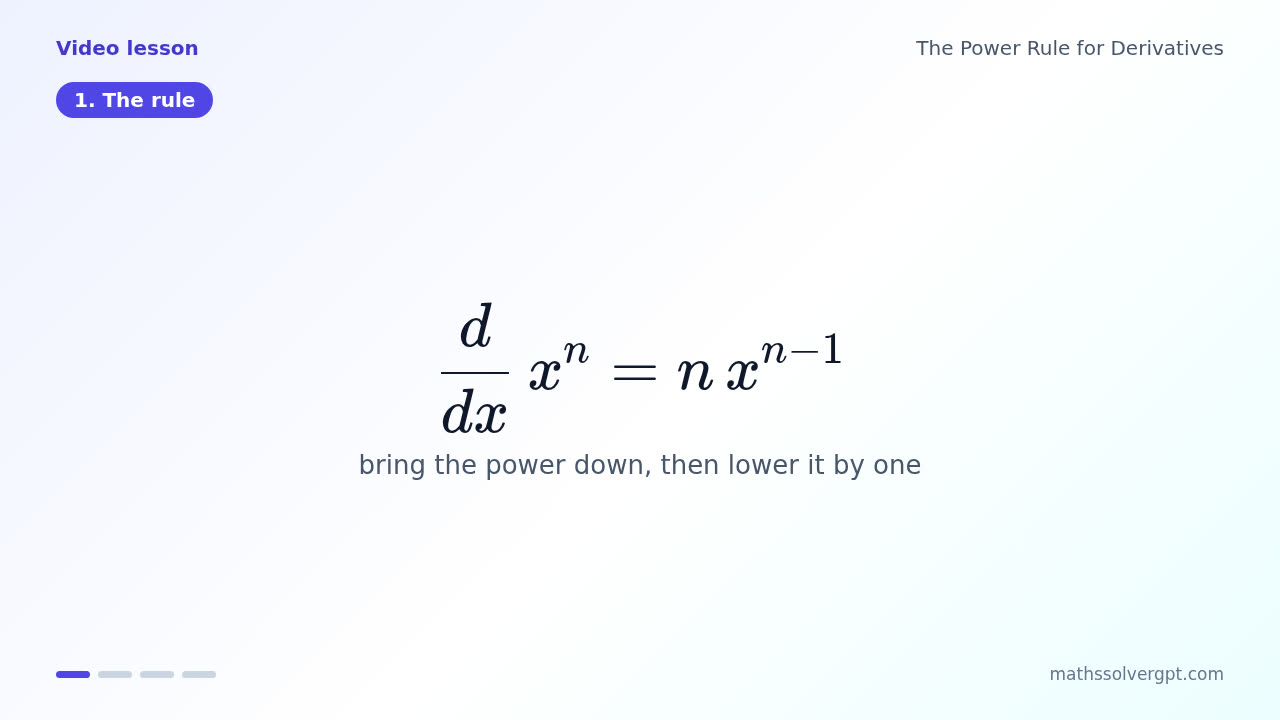
Differentiate 3x⁴ − 2x² + 7x term by term with the power rule, then use the derivative to find the slope of the tangent line at x = 1.
 0:53
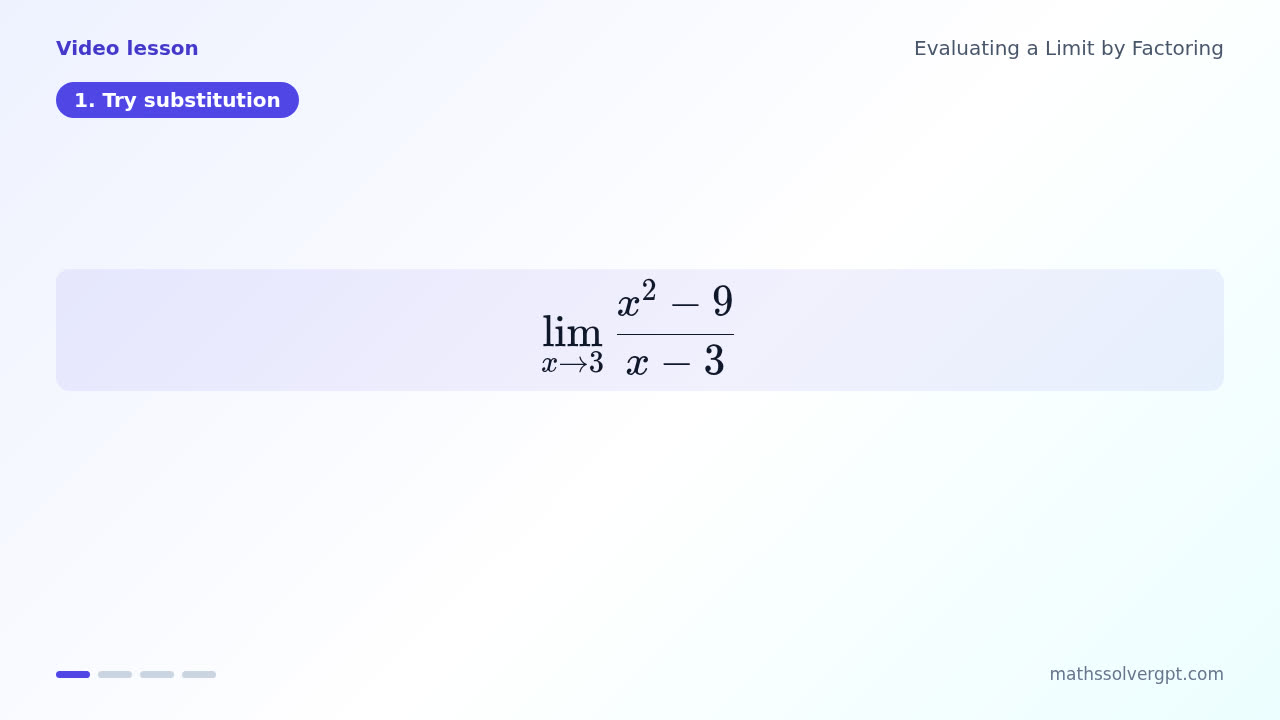
Direct substitution gives 0/0 for the limit of (x² − 9)/(x − 3) as x → 3. Factor, cancel and substitute to get 6, and see the hole on the graph.
 0:47
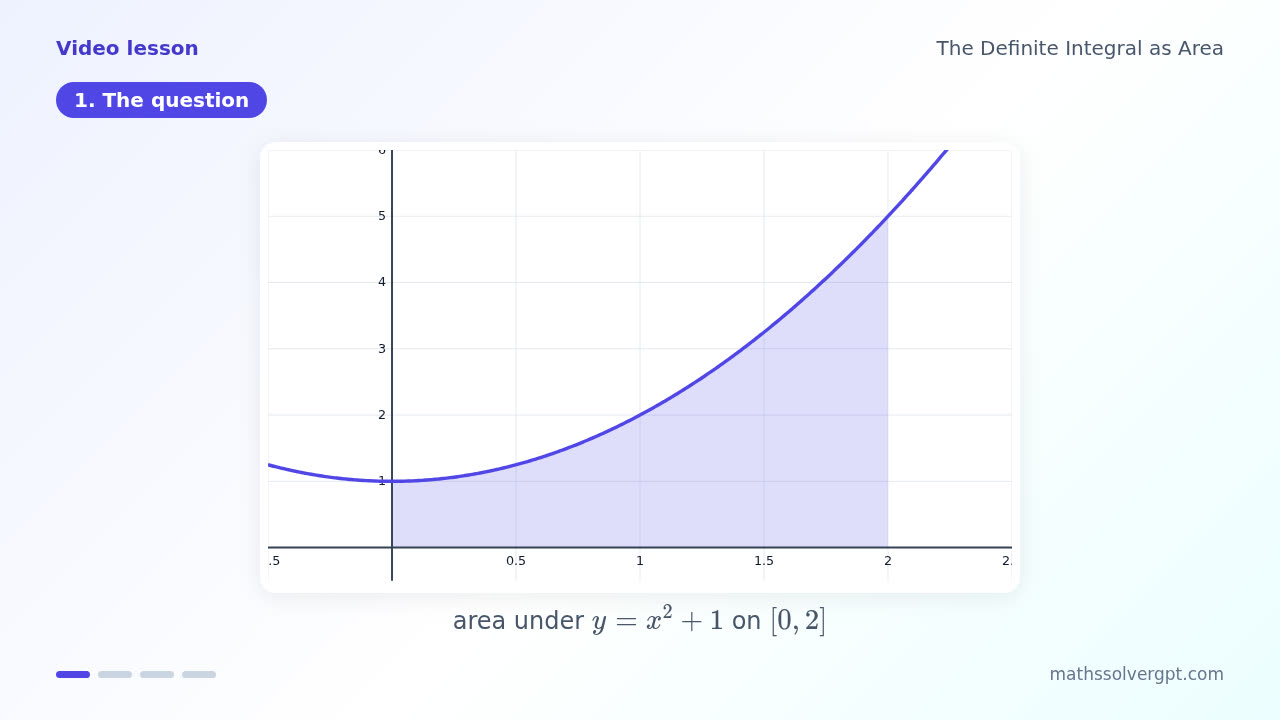
Find the area under y = x² + 1 from 0 to 2 with an antiderivative and the Fundamental Theorem of Calculus: 14/3, about 4.67 square units.