The Definite Integral as Area
Find the area under y = x² + 1 from 0 to 2 with an antiderivative and the Fundamental Theorem of Calculus: 14/3, about 4.67 square units.
Narrated by a synthetic voice (Piper TTS, en_US-ljspeech-high voice (LJ Speech dataset, public domain)). Download MP4 (0.5 MB) · Captions (WebVTT)
On-screen maths
Every board from the lesson, so you can read it at your own pace or copy it into your notes.
- 1. The question0:00
area under on - 2. Antiderivative0:14
- 3. Fundamental Theorem0:24
- 4. Recap0:40
- Find any antiderivative .
- .
- Above the axis, the integral is the area.
About integrals
Antiderivatives, substitution and the Fundamental Theorem.
Practise what you just watched
The Fundamental Theorem with the power rule for antiderivatives.
Antiderivative x squared, evaluated at the bounds.
A basic trigonometric antiderivative; do not forget the constant.
The area of a triangle with base 4 and height 4.
- Integral Calculator: try the same kind of problem with your own numbers.
- Definite Integral Calculator: try the same kind of problem with your own numbers.
- More calculus practice problems
- Limits Study Guide (study guide)
- AP Calculus AB Unit 6: Integration and Accumulation of Change: the AP unit this lesson supports.
- Calculus calculators and topics
- Step-by-step solver: check your own answer with hints.
Unofficial study material. This site is an independent educational resource and is not affiliated with or endorsed by the College Board. AP® is a trademark registered by the College Board, which is not involved in producing this content.
More video lessons
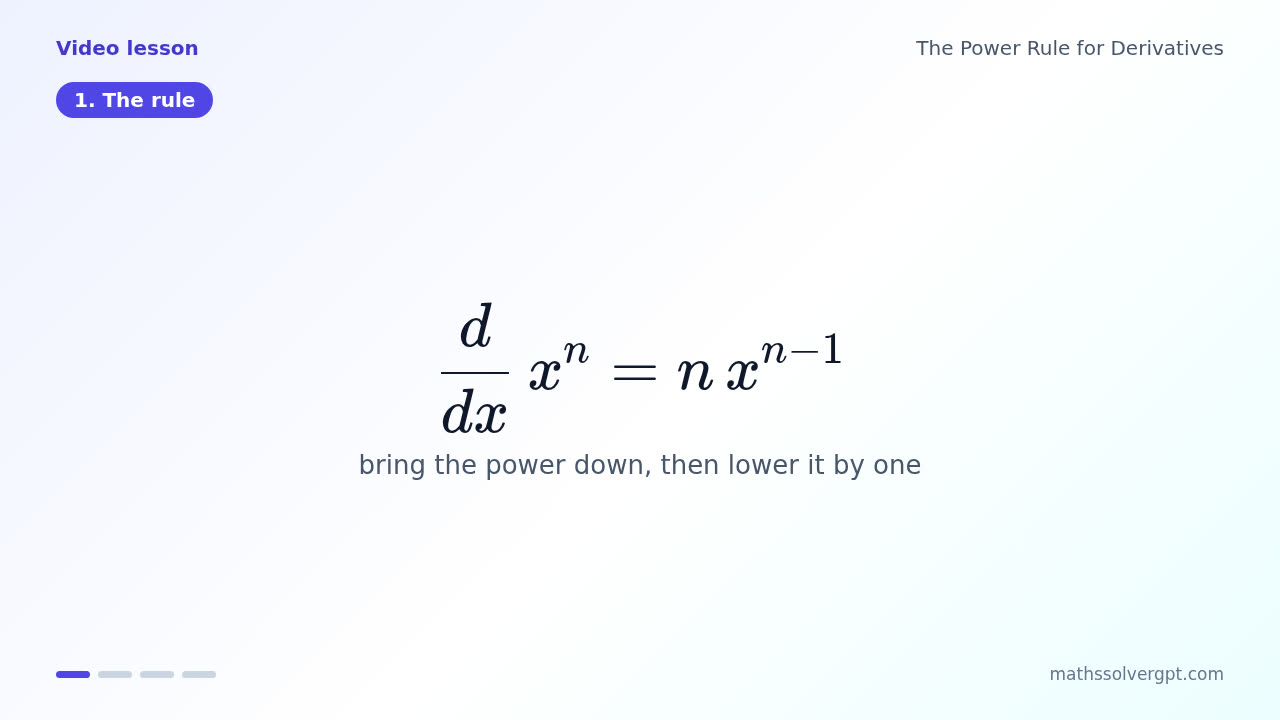 0:50
Differentiate 3x⁴ − 2x² + 7x term by term with the power rule, then use the derivative to find the slope of the tangent line at x = 1.
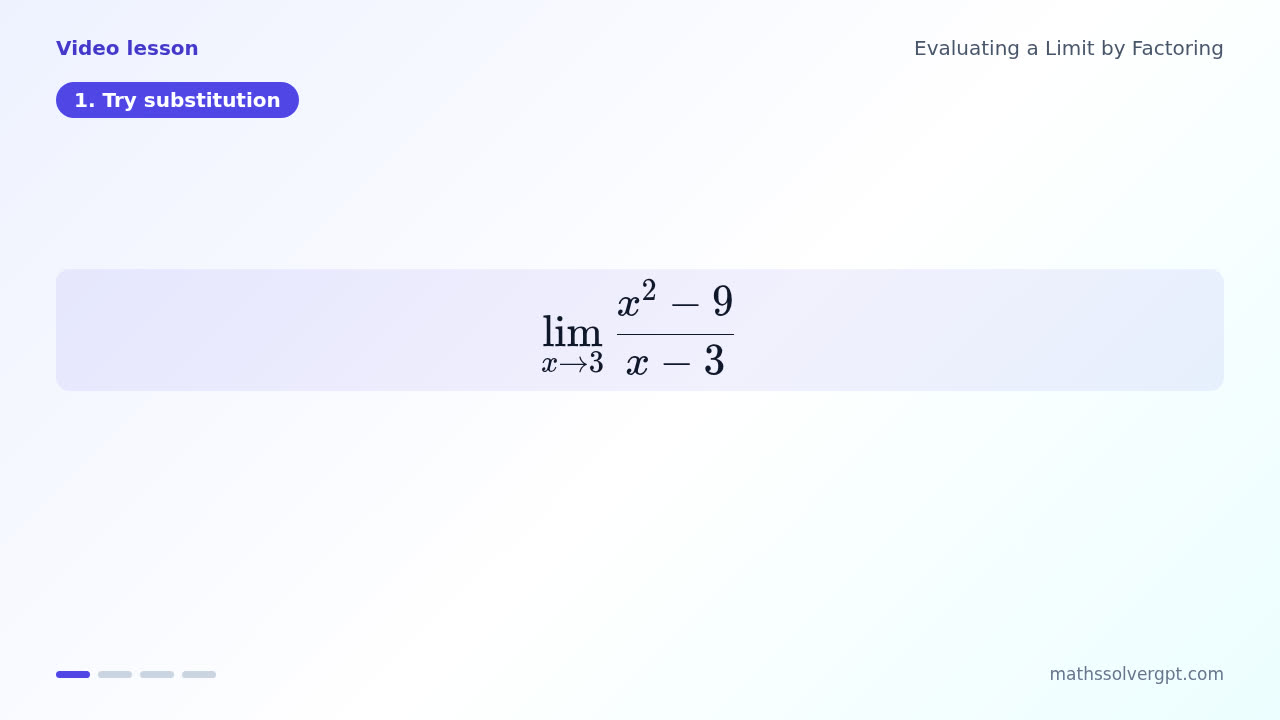 0:53
Direct substitution gives 0/0 for the limit of (x² − 9)/(x − 3) as x → 3. Factor, cancel and substitute to get 6, and see the hole on the graph.
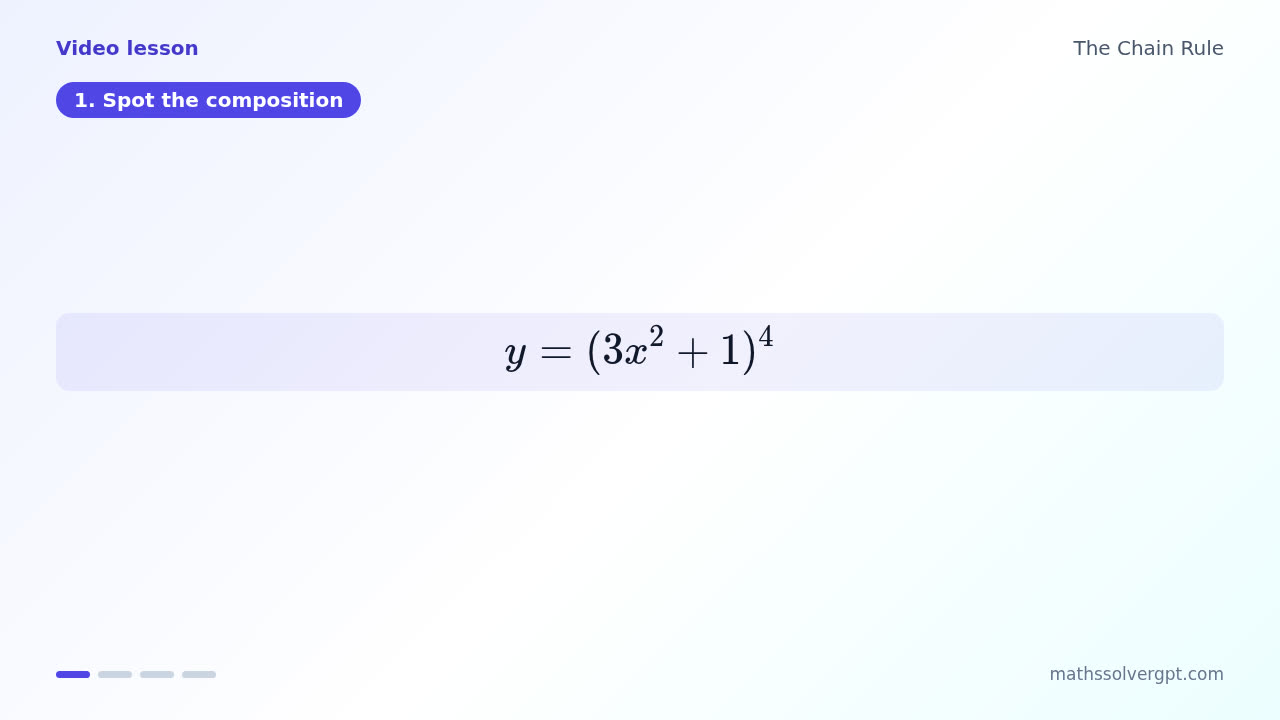 0:49
Differentiate (3x² + 1)⁴ with the chain rule: derivative of the outside, times derivative of the inside, giving 24x(3x² + 1)³.