Math video lessons
10 short narrated lessons, 9 minutes in total, across 5 subjects. Each one walks through a single worked example with captions, chapters and a full transcript you can click to jump around. The animated lesson library adds 2,031 more step-by-step lessons in 57 topics of maths, chemistry and physics.
Start here
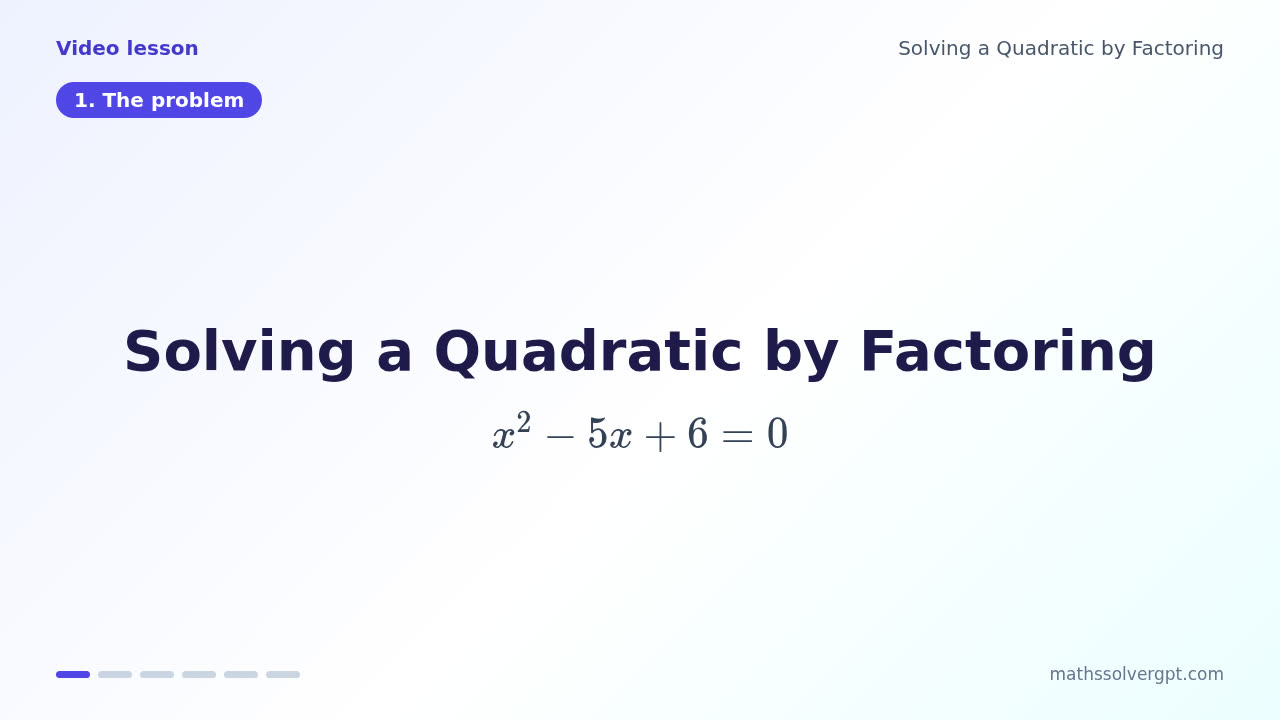 1:17
Solve x² − 5x + 6 = 0 by finding two numbers with the right product and sum, then check the roots on the graph and by substitution.
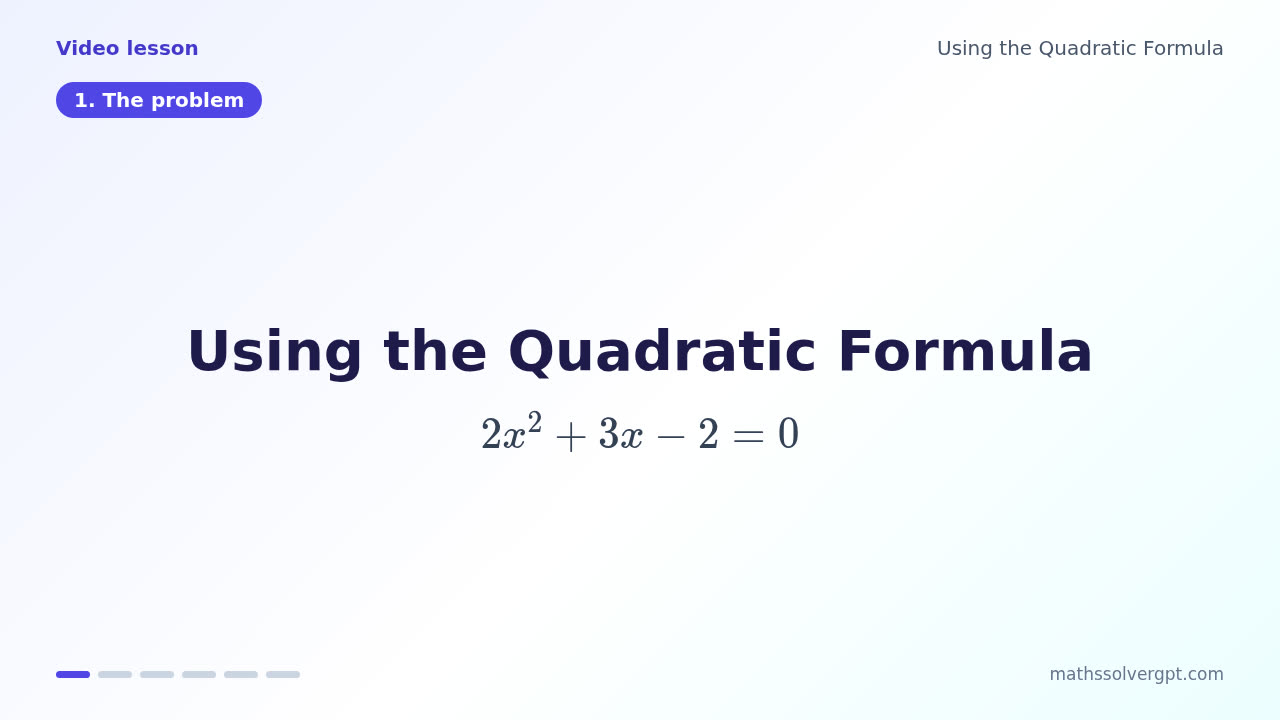 1:20
Solve 2x² + 3x − 2 = 0 with the quadratic formula: identify a, b and c, use the discriminant, simplify both roots and confirm them on the graph.
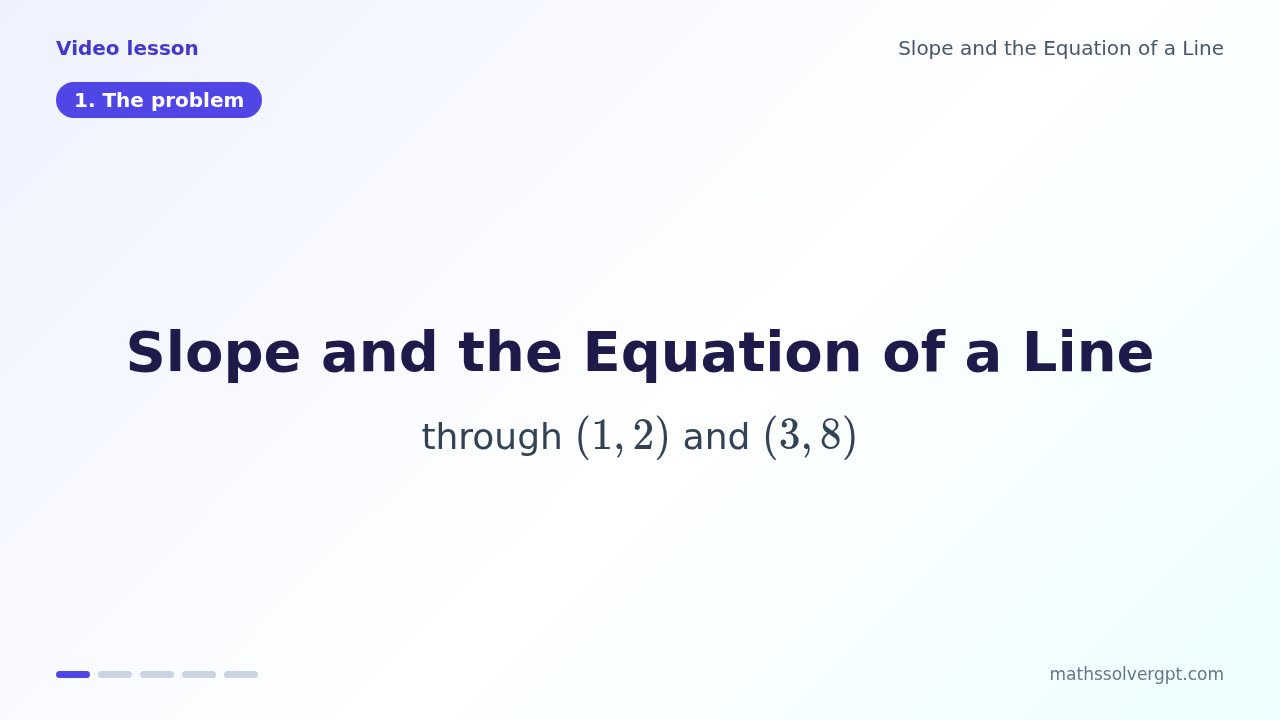 0:57
Find the slope through (1, 2) and (3, 8), build the line y = 3x − 1 in slope-intercept form, and check both points on the graph.
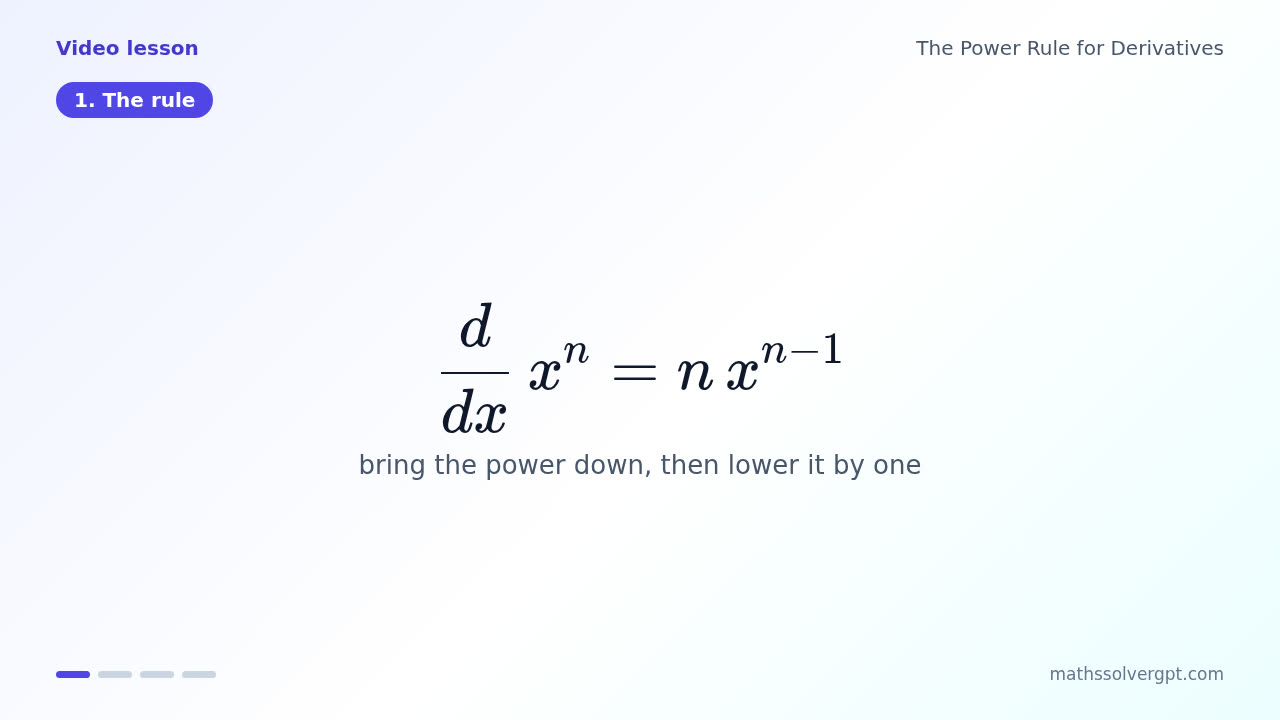 0:50
Differentiate 3x⁴ − 2x² + 7x term by term with the power rule, then use the derivative to find the slope of the tangent line at x = 1.
 0:53
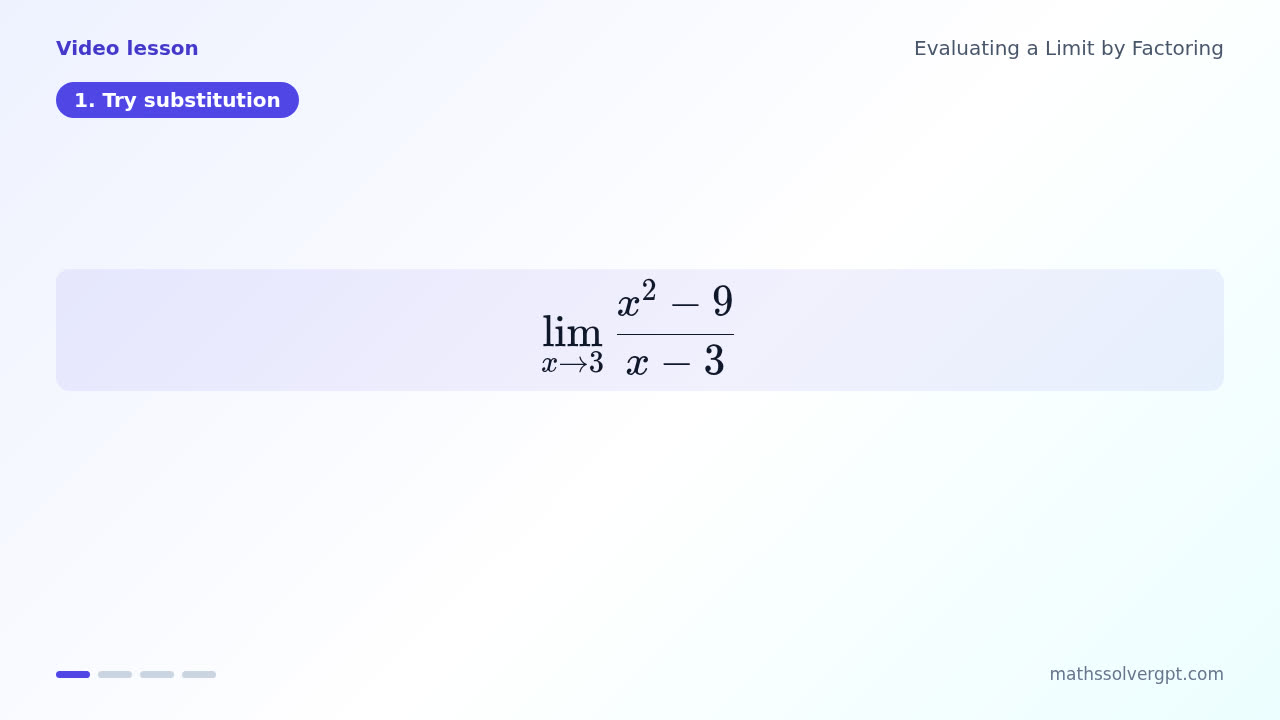
Direct substitution gives 0/0 for the limit of (x² − 9)/(x − 3) as x → 3. Factor, cancel and substitute to get 6, and see the hole on the graph.
 0:47
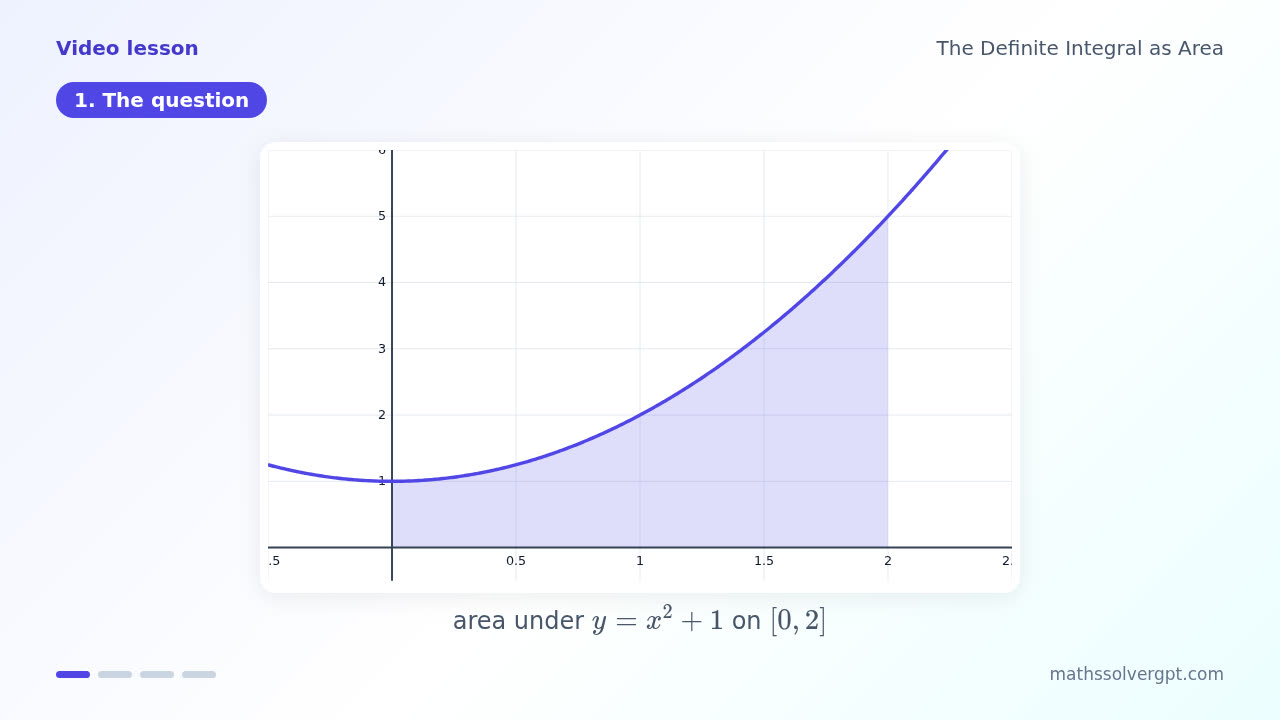
Find the area under y = x² + 1 from 0 to 2 with an antiderivative and the Fundamental Theorem of Calculus: 14/3, about 4.67 square units.
By subject
- Algebra
- Calculus
- Geometry
- Trigonometry
- Statistics
How these lessons are made
Each lesson is written as a short script: one worked example, a few chapters, and narration in plain words. The maths on screen is typeset with KaTeX, and every result is re-checked by automated tests before a lesson is published.
The narration is a synthetic voice (the open-source Piper text-to-speech engine with a public-domain voice), not a recorded human teacher. Captions are timed from the length of each spoken sentence, so they line up with the audio, and the transcript is the exact narration.
The 2,031 lessons in the animated lesson library are made differently: they play in your browser as animated boards with captions in 16 languages, read aloud by your device's own text-to-speech voice, and every answer was checked independently before it was added.
Want to practise after watching? Try the practice problems, the step-by-step solver or the study guides.